


Note to readers
I spent months digging into the case for and against the AI bubble for my forthcoming book Obsolete: The AI Industry’s Trillion-Dollar Race to Replace Us—and How to Stop It (Nation Books, preorders ship in August, wide release is September 15).
Today’s piece focuses on the most common mistake in the bubble case, which we just got some welcome clarity on.
AI’s most dedicated hater, Ed Zitron, recently intoned that something big was coming:
One of my sources has come forward and brought me a story that will possibly burst the AI bubble …
If you’re wondering what the story is, know that it’s the information I’ve wanted for years, delivered as I have always wanted it, and I will treat it with the reverence it deserves. Imagine what the worst possible thing for me to get would be and you’re probably close. …
I can guarantee you it’ll be worth it, and you’ll be stunned by what I report.
On Monday, Zitron came through, sharing OpenAI financial data that was leaked to him. He regularly publishes 15,000 word posts, but this time he kept it short and sweet, explaining that “Due to the seriousness of this story, I am not going to do very much editorializing, as the numbers speak for themselves.” While OpenAI’s losses are, as we’ll soon see, significant, the uncharacteristic lack of analysis may better reflect the fact that the numbers don’t actually comport with the story Zitron has been selling.
The blogger and public relations consultant has emerged as the loudest and brashest proponent of the idea that generative AI is a bubble, destined to pop… any day now. Zitron makes a lot of arguments to support his position. But the most load-bearing one of all is this: the generative AI companies driving the entire industry are losing money, even on their paying customers. Here’s him writing in September:
Generative AI companies — OpenAI and Anthropic included — lose millions or billions of dollars, and so do the companies building on top of them, in part because the costs associated with delivering models continue to increase. Integrating Large Language Models into your product already loses you money, at a price where the Large Language Model provider (EG: OpenAI and Anthropic) is losing money.
I believe that generative AI is, at its core, unprofitable, and that no company building their core services on top of models from Anthropic or OpenAI has a path to profitability outside of massive, unrealistic price increases.
The only realistic path forward for generative AI firms is to start charging their users the direct costs for running their services, and I do not believe users will be enthusiastic to do so, because the amount of compute that the average user costs vastly exceeds the amount of money that the company generates from a user each month (emphasis mine).
And here’s him on a podcast in November talking about OpenAI specifically:
We’re talking a company that just the cost of doing business is two or three times what they are making in revenue. And that’s just the inference. That’s before training.
Indeed, these companies are famously unprofitable (well, before Anthropic’s unprecedented revenue tear in recent months), so why does it matter so much how they’re losing money? Well, if each additional paying customer costs more to serve than they pay you, then faster growth just brings you to bankruptcy faster. But if you profit from each new paying customer, then enough growth will bring you to overall profitability, even if you have high fixed costs (in this case, mostly from training future generations of AI models).
Put simply, if AI companies need to grow like crazy and fix their cost structure to ever become profitable, then yes, this does all look like a bubble. But if instead they profit from each unit sold, then they just need to grow like crazy to recoup training costs.
Public reporting and independent estimates have indicated that companies like OpenAI and Anthropic are profitable on serving their models, with healthy gross margins in the 30-60 percent range.
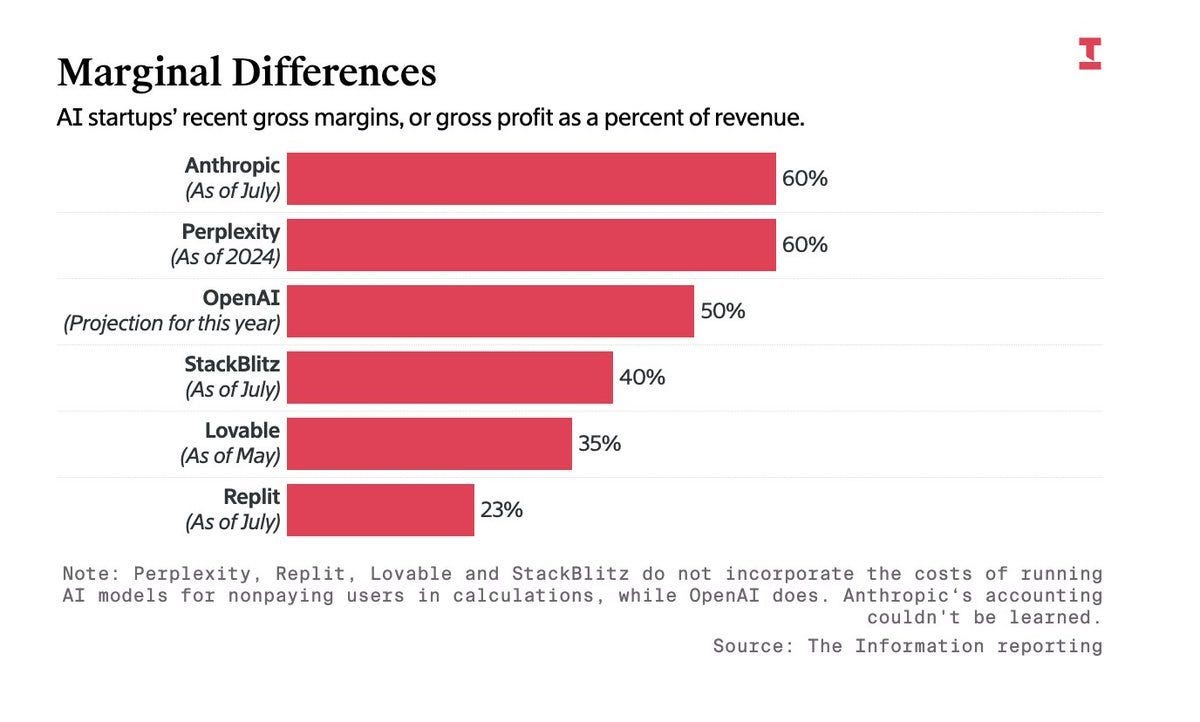
But these companies are still private, so we can’t inspect their books directly. Fortunately, someone leaked OpenAI’s audited financial statements to Zitron, who shared them with the Financial Times to validate their authenticity.
And wouldn’t you know it, OpenAI’s gross margins are positive and improving. In 2024, OpenAI’s cost of serving customers was $2.65 billion and its revenue was $3.7 billion (28 percent gross margins). Last year, cost of revenue reached $7.5 billion, but revenue more than tripled to reach $13.07 billion (43 percent gross margins).
Of course, this misses most of the costs OpenAI bore, which overwhelmingly came from R&D (i.e. training new models). And in October, OpenAI completed its restructuring as a for-profit, with the controlling nonprofit foundation taking an equity stake worth about $130 billion at the time, roughly 26 percent of the company. Here are the full numbers from Zitron:
2024:
Revenue: $3.7 billion
Cost of Revenue: $2.65 billion
Research and Development: $7.81 billion
Sales and Marketing: $1.11 billion
General and Administrative: $907 Million
Total Costs and Expenses: $12.48 billion
Loss from Operations: $8.78 billion
2025:
Revenue: $13.07 billion
Cost of Revenue: $7.5 billion
Research and Development: $19.18 billion
Sales and Marketing: $5.73 billion
General and Administrative: $1.57 Billion
Total Costs and Expenses: $34 billion
Loss from Operations: $20.92 billion
The ChatGPT creator has a tough financial road ahead of it, and the amount of money it expects to lose before becoming profitable overall ($115 billion) is nearly four-times higher than the most money a company ever burned before reaching profitability (Uber’s $31.5 billion).
It might not get there.
But all that distracts from the fact that Zitron pulled out the linchpin in his own case that the whole industry is a bubble. His data shows definitively that OpenAI makes far more from ChatGPT than it costs to serve, even while serving it to hundreds of millions of free users. And the vast majority of its users pay nothing: with 900 million weekly active users and just 50 million paying subscribers as of February.
Through a flurry of circular compute deals worth around $1.4 trillion struck last fall, the company tied its financial fate to some of the largest firms in the world. Now, if OpenAI goes down, it really could take the global economy with it. And in the meantime, it gives the company outsized power with regulators and lawmakers.
But Zitron’s bubble case long-preceded those deals and has consistently featured the claim that generative AI has negative gross margins. In October 2024, he wrote:
OpenAI’s API services — which lets people integrate its various models into external products — is currently priced at a loss, and increasing prices will likely make this product unsustainable for many businesses currently relying on these discounted rates.
And his mistaken claims about the economics aren’t some sideshow to otherwise astute observations about the technology or its future. For instance, in July 2024, he wrote that:
Generative AI, as I said back in March, is peaking, if it hasn’t already peaked. It cannot do much more than it is currently doing, other than doing more of it faster with some new inputs.
Wherever Zitron’s takes pop up, the reaction is effusive: finally, someone who knows what they’re talking about, who’s willing to call out the obvious madness! But while presenting as a courageous dissenter in a sea of charlatans and fools, he’s really just telling people what they want to hear.
And people really, really don’t want AI to be real. The inverse of Zitron’s case — the technology will actually deliver on sky high investments and expectations — implies labor displacement, further wealth and power concentration, environmental harms, and risks far graver than an economic crash.
The uncomfortable reality is that we can’t count on the bursting of a bubble to save us — there’s far too much at stake. The less appealing message is that AI companies are trying to render us obsolete, and the only surefire way they won’t succeed is if we stop them. And that’s going to involve a lot of hard work.
But I’ll take that over waiting around for the supposedly inevitable.
P.S. Ed, if you’re reading this, I know Richard Hames from Novara Media invited you to debate me. I just want to say for the record that I’m game — any time, anywhere.
I want to clarify that I never claimed that OpenAI is a profitable business, or even has a good or sustainable business model, but simply that this data falsifies a big claim that Zitron has repeatedly made. He seems to have moved the goal posts to claiming that training costs should count toward the gross margins, but that is a totally different argument.
If you make money from your customers on average, you can grow your way to recouping even very high fixed costs. If you instead lose money from the typical customer, as Zitron repeatedly contended, then growing more will make you run out of money faster. This is an incredibly important distinction, and getting it wrong for so long (in the face of reporting from the Information, which Zitron favorably cites elsewhere, as well as independent estimates) is frankly disqualifying for a commentator on AI industry economics.
As someone who's been in startups for more than a decade this tale is hilarious. LTV/CAC is everything... And you are just completely disregarding sales and marketing. I know a lot of companies that were amazing businesses if you just looked at LTV compared to AWS payments. Another question is where GPU depreciation is hiding.