


I’ll be interviewed by Nation executive editor John Nichols at noon today for a live virtual discussion about my forthcoming book Obsolete (with a healthy audience Q&A portion). Attendance is free, but requires registration.
On Tuesday, former OpenAI researcher Jacob Coxon resigned from Anthropic with a dire warning, writing, “The people building AI earnestly believe that it could kill us all by the end of the decade. This is not a marketing stunt.” To AI insiders, this wasn’t news, but after the seemingly never-ending Holy Shit AI Is A Big Deal newscycle kicked off by revelations that OpenAI agents autonomously cyberattacked Hugging Face, Coxon’s message broke through in a way nothing else ever has. Of course, his message’s resonance has prompted conspiracy theories from the usual suspects. But no astroturf campaign can wrack up over 100 million views on X in a day. Because if it could, the AI industry would have a much better image.
As a journalist, sometimes you grind for months or years to land a scoop — exclusive, newsworthy information you get to break to the world. And sometimes, they fall in your lap.
That’s what happened to Taylor Lorenz, who was offered money to shill a message about the purported dangers of Chinese AI by a dark money group called Build American AI. She then wrote up the whole campaign for WIRED in May. As the leading journalist on the murky, loosely regulated intersection of influencers and politics, Lorenz is probably the funniest possible person to invite into the network. Here she is explaining the situation:
Marketing agencies are pitching influencers deals such as $5,000 per TikTok video to amplify Build American AI’s messaging about how China’s technological rise should be seen as a threat. The goal, according to a staffer from SM4, the influencer marketing agency running the campaign on behalf of Build American AI, is to subtly shift public debate by framing China’s AI advancement as a serious risk to the safety and well-being of Americans.
Build American AI is a political advocacy nonprofit sister organization to Leading the Future (LTF), an AI industry super PAC dumping millions into destroying midterm candidates who had the temerity to regulate them (or even try).
The week before Lorenz’s article, Tyler Johnston of industry watchdog the Midas Project caught Build American AI paying a contractor that was using AI “journalists” to smear industry critics. LTF played dumb, tweeting:
We were not aware of this platform until we saw the article, and our organization does not use it. It appears that a third-party vendor used it without our knowledge, and their engagement with us has been terminated.
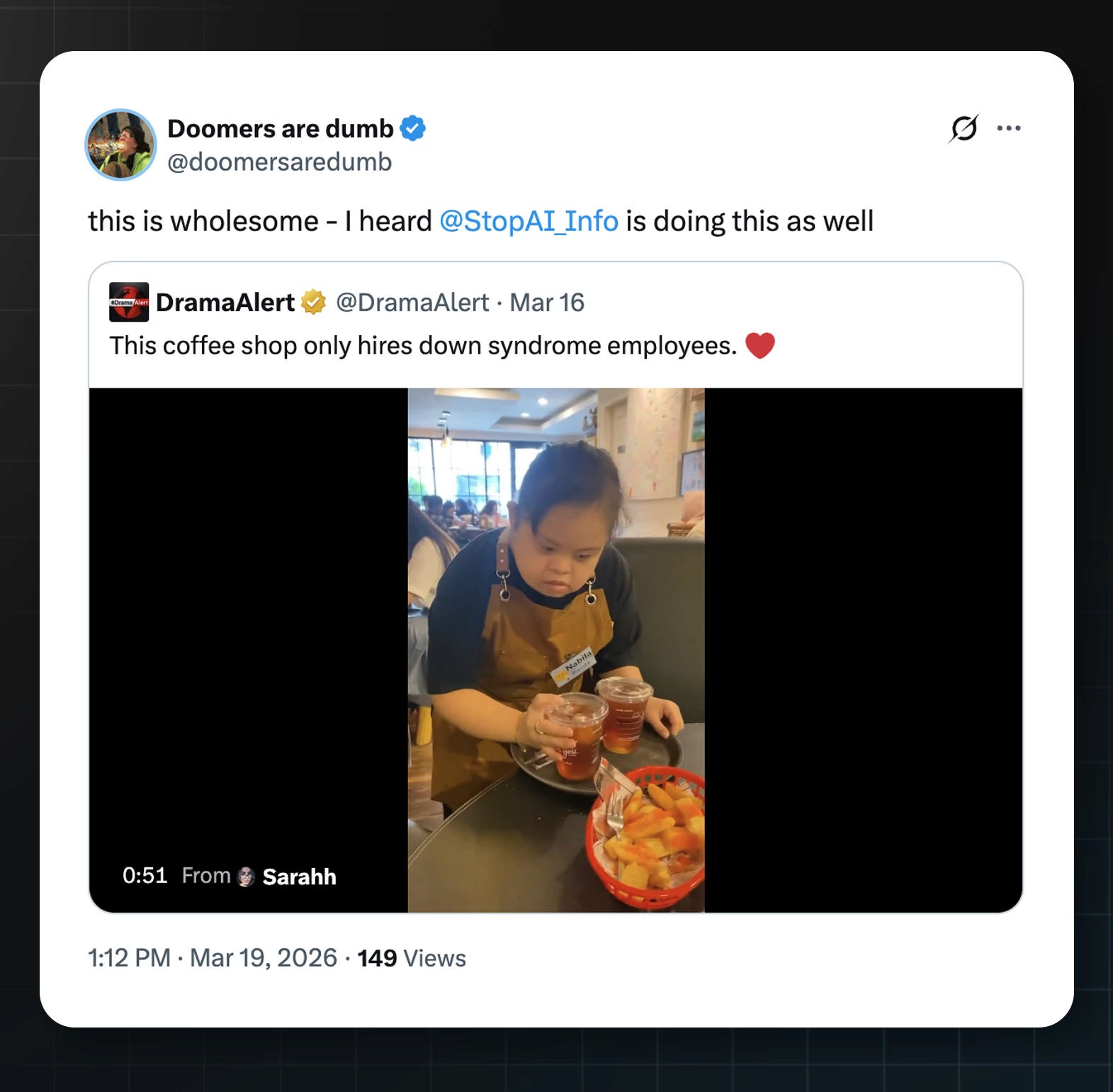
But in the intervening weeks, Johnston also documented how social media posts affiliated with LTF-backed orgs were being boosted by barely legal pornbots named Melanie. More recently, Lorenz and Johnston teamed up and connected Build American AI to two X accounts, ostensibly on opposite sides of the AI issue: “Doomers are dumb” and “John Doomer.”
Here’s one charming example post from “Doomers are dumb”:
Most shocking, however, is the violent rhetoric employed by “John Doomer” — the same variety blamed for attacks on Sam Altman’s property. Lorenz and Johnston describe it:
@JonathanDoomer often deploys the same sort of inflammatory language that has been blamed for the attacks on Sam Altman by various figures associated with the super PAC. One post from the account, made two weeks before the attack on Altman, depicts an assault rifle and the phrase “we don’t call 911” in response to a warning about AI. Another post compares Sam Altman to a caterpillar that “murders insects” and “stitches their dismembered body parts onto its back as armor.” Various other posts from the account call supporters of AI “assimilated” and “organic drone[s],” claim that we are less than 12 months away from an AI-induced apocalypse, and boast about mailing dryer lint to the corporate headquarters of tech companies in an attempt to sabotage data center HVAC systems.
Leading the what now?
But as concerning and salacious as all these details are, I want to turn our attention to something else. In the WIRED story, Lorenz writes, “An OpenAI spokesperson says that OpenAI has no corporate affiliation with Leading the Future or Build American AI and has ‘not provided funding or any other support to them.’”
This was not the first time the company has tried to distance itself from these groups, but it was the sharpest. For instance, also in May an OpenAI spokesman told the New York Times:
the company and super PAC were separate entities and that OpenAI had “prioritized creating and improving cutting-edge safety systems in an entirely new industry and proposed some of the strongest kids’ safety regulations in the country.”
OpenAI employees have said similar things online. Take Roon, the company’s popular, pseudonymous online voice:
It is definitely a mistake to think Leading the Future is equivalent to the OAI Global Affairs group. they have entirely opposite views on certain issues.
And OpenAI’s since-departed chief futurist Joshua Achiam:
I try to avoid putting words in other people’s mouths. But fwiw I’m not aware of any relationship that the company has, as a company, with him [LTF target Alex Bores]. I don’t really expect to convince you that this is a meaningful distinction, so I won’t try. You QT’d me so I gave you my perspective.
In June, OpenAI Global Affairs published a post titled “Our views on AI policy and political advocacy.” I’ll quote the relevant part in full:
In particular, there have been questions around Leading the Future (LTF), which has received support from our President and co-founder, Greg Brockman, and his wife Anna. As they’ve stated before, any engagement with that organization has been in a personal capacity, not on behalf of the company. OpenAI does not direct the activities of LTF, or have visibility into their operations.
We want to be explicit: No outside political group speaks for OpenAI or represents our company’s views.
OpenAI’s policy views should be judged by what we say and do publicly, and we should be held to a high standard …
(OpenAI did not respond to questions and a request for comment sent Wednesday at 3:40PM eastern.)
But these OpenAI employees appear to be about the only people buying it. Responding to Roon’s tweet, DC AI policy strategist Dave Kasten wrote:
It’s really important for OpenAI folks to know that in DC, LTF is seen as the real voice of OpenAI, not Global Affairs folks. Everyone in DC AI policy routinely hears Congressional offices say “OpenAI wants” and then describe what LTF wants, because it’s funded by your C-suite.
And former OpenAI lawyer Michael Page replied with:
My understanding (correct me if I’m wrong) is that (i) without Chris Lehane, LtF wouldn’t exist in its current form, and (ii) Chris Lehane could kill LtF in its current form. If that’s true, then I stand behind the connection. If not, I apologize.
(No one corrected him.)
As New York Times reporter Teddy Schleifer separately explained:
The whole point of having an executive or founder donate to politics in a “personal capacity” is that you can have it both ways.
If the company wants to wash their hands of it, you can say “Hey, he and his wife are doing this on their own.”
But the company can also claim the execs’ donations as their own if convenient…
What could possibly give you that impression?
So why do DC people think of LTF as the ambassador of OpenAI’s will?
Well, for starters, company cofounder and president Greg Brockman donated $25 million to it (on top of the $25 million he donated to Trump’s super PAC last year). And when Brockman spoke to WIRED in February, Max Zeff wrote that, “According to Brockman, these political donations are in service of OpenAI’s founding mission: to develop highly capable AI systems and distribute the benefits to all of humanity.” (That’s not actually OpenAI’s mission, but that’s a separate story.) And here’s a relevant passage from the Wall Street Journal article on the creation of LTF:
Andreessen Horowitz’s head of government affairs, Collin McCune, Brockman and OpenAI chief global affairs officer Chris Lehane were involved in initial conversations earlier in the year about the need to help shape industry-friendly policies.
Zeff also interviewed OpenAI’s chief lobbyist and reported that while Lehane “helped set up” LTF:
Lehane says he’s currently “not involved” in the day-to-day operations or decisionmaking at Leading the Future and hasn’t shared feedback with the group about its efforts since it launched. He has tried instead to “let them be their own independent outside thing.” He adds that OpenAI has repeatedly tried to clarify, including in internal blog posts directed at employees, that it does not directly fund any super PACs.
I’ll leave the significance of the word “directly” to the reader. Moreover, has Lehane directed LTF to stop any of the dirty tricks documented above? Has Brockman? Whether or not they’re still involved with LTF, are they powerless to redirect or stop it now?
Oh, and in June, Build American AI executive director Nathan Leamer texted Veronica Irwin of Transformer that directly referred to OpenAI as a funder, something the company continued to deny in its statement to Irwin.
Finally, LTF is doing more or less what Lehane did for the crypto industry, as detailed in Charles Duhigg’s New Yorker profile. Here’s a relevant passage from my forthcoming book Obsolete:
During the 2022 midterms, Lehane organized a crypto industry super PAC that intimidated Congress into embracing digital currencies using whatever political attacks were most expedient (which never mentioned crypto). As one person familiar with the PAC’s strategy told the New Yorker: “If you are even slightly critical of us, we won’t just kill you—we’ll kill your fucking family, we’ll end your career.”
Nathan Calvin, the general counsel for AI policy advocacy group Encode AI, explains the connection further:
Josh Vlasto, one of the two co-lead of Leading the Future, also worked closely with Chris Lehane when Vlasto served as the main spokesperson for the Crypto Super PAC Fairshake network - the Super PAC that Chris Lehane effectively created and helped run when he was at Coinbase (where Lehane still sits on the board!). The structure of LTF bears significant similarity to what Lehane helped set up with Fairshake.
The pattern is becoming clear: OpenAI leadership wants to kill regulations using any means necessary. Some of their employees don’t like that, so executives are putting layers between the company and dirty tricks employed on its behalf. DC knows better, but employees, at least some of them, don’t. It’s a great deal for OpenAI, but not such a great deal for the rest of us.
AI researchers are scarce, so they have substantial leverage over their employers. I believe this is why OpenAI was relatively transparent about the HuggingFace attack: maybe they could have tried to hide it from the public, but it would have turned their employees against them. If OpenAI can prevent its own employees from feeling responsible for LtF that's a victory even if they can't convince anyone else.